
Botanical Identity & Classification
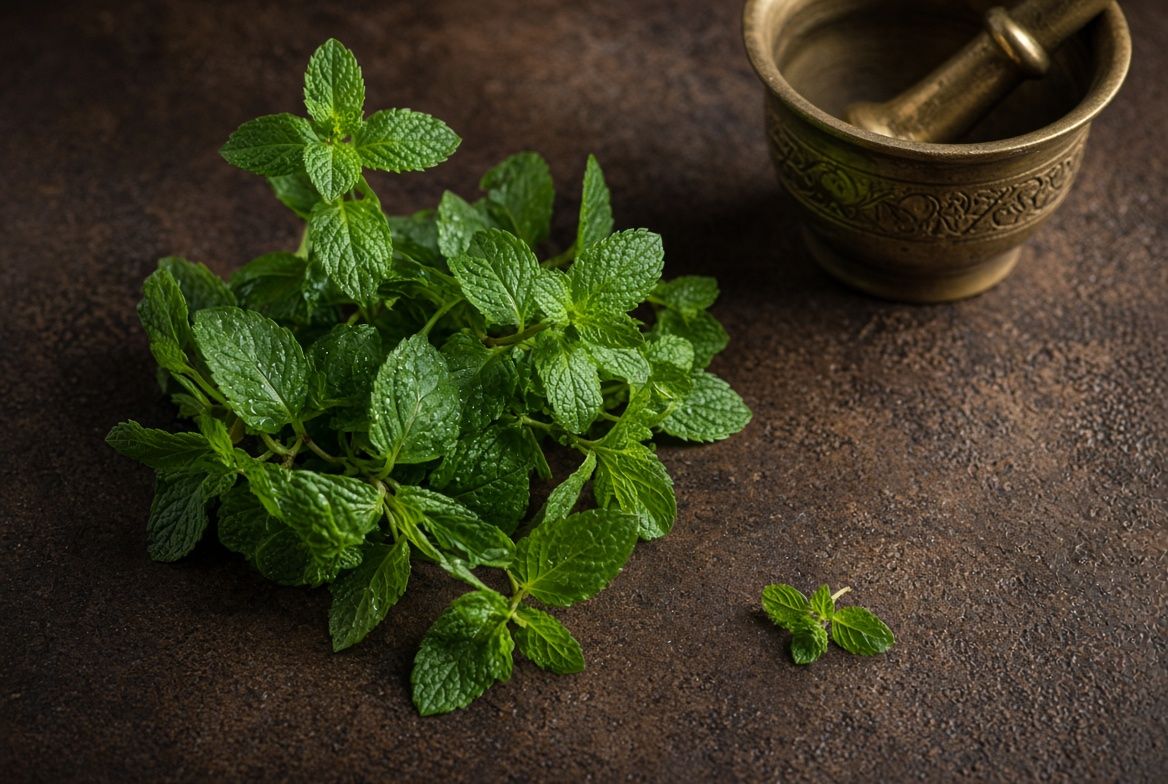
Inventory scope: Mentha spicata · Lamiaceae · leaf.
Nomenclatural check: Mentha spicata L. is accepted in this treatment (family Lamiaceae). The stated native range is Europe to China (Kew, Plants of the World Online: Mentha spicata L.).
Inventory decision: Distinguish from hybrid peppermint and from oil or standardized extracts. Keep species-specific research separate from descriptions of “mint” in historical texts.
The NC State Extension profile identifies spearmint as Mentha spicata in the mint family, Lamiaceae, and lists Garden Mint, Lamb Mint, and Mint as common names (Spearmint - Mentha spicata).
The BSBI species account identifies Mentha spicata L. as Spear Mint, sometimes called Common Spear Mint, and lists M. viridis (L.) L. as a synonym (Mentha spicata L., Spear Mint).
Botanical & Scientific Profile
Spearmint and peppermint are not simply weaker and stronger versions of one ingredient. Keep cultivar, preparation and oil chemistry visible before attributing a sensory difference to species alone.
The NC State Extension profile describes spearmint as having significant economic value as a flavoring in chewing gum and tea and as an essential-oil crop (Spearmint - Mentha spicata).
The NC State Extension profile describes spearmint as a perennial with nearly glabrous, nearly sessile leaves, square stems, and small flowers in terminal spikes; it lists the leaves and flowers as edible (Spearmint - Mentha spicata).
Cultural History & Traditional Herbalism
The BSBI account says Spear Mint was greatly appreciated by the Romans and is mostly used for culinary purposes. It also reports that ancient Greeks and Romans used mint to perfume rooms and baths and as a restorative, like smelling salts (Mentha spicata L., Spear Mint).
The BSBI account says Spear Mint’s distilled oil is used to flavour toothpaste and chewing gum and to perfume soap (Mentha spicata L., Spear Mint).
The review reports that Moroccans consume tea daily as an infusion of Mentha spicata and Mentha viridis leaves. In the Tafilalet region, a cited ethnobotanical survey records M. spicata (vernacular names Liqama and Naanaa), using leaves and stems for hypertension and cardiac diseases; in Rabat, M. spicata (Naanaa) leaves are reported for gastrointestinal disorders, skin pathologies, and burns, including external application of an essential-oil poultice or fresh-leaf paste mixed with olive oil. In Oujda, the review lists M. spicata (Liqama and Naanaa) for gastrointestinal disorders, hemorrhoids, pregnancy and childbirth complications, infectious and parasitic diseases, burns, and symptoms including headache and thirst; the plant part and route of administration are not specified in that table entry (Characterization, activities, and ethnobotanical uses of Mentha species in Morocco).
Tradition, Folklore & Symbolism
The NC State Extension profile links the genus name Mentha to the Greek myth of Minthe, a water nymph transformed into a mint plant by Persephone in revenge for Minthe’s affair with Hades (Spearmint - Mentha spicata).
The BSBI account says Turner called garden mint “Spere Mynte” in 1566 and attributed the name to the leaf shape rather than the spiked inflorescence. It also lists Brown Mint, Garden Mint, Mackarel Mint, Our Lady’s Mint and Spearmint as English names recorded under the synonym M. viridis (L.) L (Mentha spicata L., Spear Mint).
Herbal Energetics
Insufficient documented evidence for a traditional energetic classification. No temperature, direction or channel is inferred from the flavor of a cup.
InfiniTea sensory metaphor: A gentler turn. This is original editorial language, not a measured physiological action or a translation of a traditional diagnostic category.
Sensory Profile & Tea Applications
The NC State Extension profile describes spearmint leaves as having a strong spearmint fragrance and taste (Spearmint - Mentha spicata).
The BSBI account describes Mentha spicata as a scented plant and says its familiar, distinctive aroma makes it easily identifiable when bruised. It describes the taste of Spear Mint as more pleasant and less strong than Peppermint (Mentha spicata L., Spear Mint).
The study made iced teas using spray-dried, microencapsulated extracts prepared from pressurized hot water extracts of spearmint (Mentha spicata L.) and peppermint (Mentha piperita L.). GC–FID measured 0.30–0.32 mg/100 mL carvone in spearmint iced teas and a combined 6.51–6.75 mg/100 mL of menthol, menthone, and methyl acetate in peppermint iced teas. Sensory results showed no significant differences between teas made with citric acid and those made with microencapsulated lemon extract; peppermint iced teas were characterized by nasal and oral cooling sensations (Ready to drink iced teas from microencapsulated spearmint (Mentha spicata L.) and peppermint (Mentha piperita L.) extracts: physicochemical, bioactive and sensory characterization).
Sensory notebook: Compare labeled spearmint and peppermint by aroma and cooling impression. Describe what distinguishes the samples without treating smell as authentication.
Proposed comparison, not a completed trial: Record aroma and perceived cooling on separate lines for a labeled spearmint and peppermint. Compare like preparations rather than tea against an essential oil.
For ordinary dried herbal or fruit infusions, the German Federal Institute for Risk Assessment advises using boiling water and not leaving the prepared infusion standing for hours. Cooling a hot infusion and steeping untreated dry material in cold water are different processes; this report does not validate the latter (Boiling water a must for herbal teas).
Safety & Responsible Use
The NC State Extension profile lists spearmint leaves and flowers as ingredients for teas and says large ingestions may cause vomiting and diarrhea; it identifies essential oils as the toxic principle (Spearmint - Mentha spicata).
A two-centre, 30-day randomized controlled trial compared spearmint herbal tea taken twice daily with placebo herbal tea in 42 volunteers; 41 completed the study, and the reported outcomes included hormone levels and hirsutism ratings (Spearmint herbal tea has significant anti-androgen effects in polycystic ovarian syndrome. a randomized controlled trial).
No severe adverse events were reported, there were no significant between-group differences in the number of participants reporting adverse effects, and the reported events could not be attributed to the extract. The page reports no contraindication, interaction, allergy, pregnancy, or lactation findings; it also reports no effect on follicular stimulating hormone, luteinizing hormone, thyroid stimulating hormone, vital signs, plasma chemistry, or whole-blood hematology values (Safety and tolerability of a dried aqueous spearmint extract).
Preparation and exposure boundary: This review does not establish a safe medicinal dose in pregnancy, lactation or childhood, or rule out interactions or allergy. Do not substitute essential oil or a concentrated extract for the documented food or herb.
For U.S. food use, the relevant safety determination concerns the intended conditions of use. The existence of a traditional preparation or herbal medicine monograph does not establish that this ingredient, dose and beverage are cleared for sale (Understanding How the FDA Regulates Food Additives and GRAS Ingredients).
Historical Trade, Ecology & Sustainability
The NC State Extension profile identifies spearmint as native to Europe and says it grows naturally in moist fields and along pond or lake margins; it lists the species as introduced in Canada, the United States, southeastern South America, and northern Africa (Spearmint - Mentha spicata).
The BSBI account says Mentha spicata grows in lowland damp or wet places, often in ditches, riverbanks, and rough or waste ground near habitation. It says garden mints can appear on waste ground or tips near towns and villages, where they can become naturalised and may persist for a long time (Mentha spicata L., Spear Mint).
The NC State Extension profile says spearmint attracts butterflies (Spearmint - Mentha spicata).
Sourcing record: Request the Mentha species, cultivar if known and harvest cut; do not infer identity from a Moroccan-style blend name.
InfiniTea Herb Lore & Ritualpreliminary draft
Energetics (original InfiniTea metaphor): A gentler turn. Use this as a private writing image, not a health statement.
Tradition & Folklore: The NC State Extension profile links the genus name Mentha to the Greek myth of Minthe, a water nymph transformed into a mint plant by Persephone in revenge for Minthe’s affair with Hades (Spearmint - Mentha spicata).
Ritual Cue (original contemporary InfiniTea interpretation): Rewrite one instruction as an invitation. Read both aloud to hear the change.
Private preliminary draft; not approved for publication.
Scholarly References & Research Verification
Research limitations
Confirm the species and form, especially when literature describes encapsulated oil rather than an infusion. A mint trade name is insufficient for a chemotype claim.
The accessible page provides no sensory-panel size or detailed sensory-testing methods (Ready to drink iced teas from microencapsulated spearmint (Mentha spicata L.) and peppermint (Mentha piperita L.) extracts: physicochemical, bioactive and sensory characterization).
References below identify the evidence used, not additional endorsements. A botanical authority establishes nomenclature, not the identity of a physical lot. Published study samples, traditional descriptions and InfiniTea proposals are distinguished in the text.
- Kew, Plants of the World Online: Mentha spicata L. | Taxonomic backbone
- Spearmint - Mentha spicata | Horticultural plant profile
- Mentha spicata L., Spear Mint | botanical species account
- Spearmint herbal tea has significant anti-androgen effects in polycystic ovarian syndrome. a randomized controlled trial | randomized controlled trial
- Ready to drink iced teas from microencapsulated spearmint (Mentha spicata L.) and peppermint (Mentha piperita L.) extracts: physicochemical, bioactive and sensory characterization | laboratory study
- Characterization, activities, and ethnobotanical uses of Mentha species in Morocco | Review synthesizing Moroccan publications on Mentha species characterization, activities, and ethnobotanical surveys.
- Safety and tolerability of a dried aqueous spearmint extract | A double-blind, randomized, placebo-controlled trial evaluated a dried aqueous extract of spearmint (Mentha spicata L.), standardized to rosmarinic acid, in healthy adults with age-associated memory impairment. Participants received 600 or 900 mg/day for 90 days; the plant part was not specified.
- Boiling water a must for herbal teas | BfR press release providing general food-safety guidance for preparing herbal and fruit infusions.
- Understanding How the FDA Regulates Food Additives and GRAS Ingredients | U.S. FDA consumer-information webpage describing food-additive and GRAS ingredient oversight.
Final Botanical Summary
Spearmint merits its own record, not a peppermint profile with a new title. A regional mint drink also contains choices made by its preparers.
Editorial disposition: Lot unverified. The report is a private reference, not a clinical recommendation, approval for sale or authenticated sensory trial.
Verification Status (November 2026)
Phase II source audit, claim by claim
- Claims checked
- 16
- Corrected
- 3
- Withheld
- 1
- Sources
- 9
Material: Lot unverified. No physical sample has been examined.
Citation check: All 4 Safety & Use citations were re-read against their sources in November 2026 and confirmed.
A private research reference, not a clinical recommendation or product claim. Checked to the Grimoire's research standards →