
Botanical Identity & Classification
Inventory scope: Illicium verum · Schisandraceae · dried aggregate fruit.
Nomenclatural check: Illicium verum Hook.f. is accepted in this treatment (family Schisandraceae). A synonym listed there is Illicium stellatum Makino. The stated native range is China (S. & W. Guangxi) to N. Vietnam (Kew, Plants of the World Online: Illicium verum Hook.f.).
Comparison taxon; not a substitute: Illicium anisatum L. is accepted in this treatment (family Schisandraceae). A synonym listed there is Badianifera anisatum (L.) Kuntze (Kew, Plants of the World Online: Illicium anisatum L.).
Inventory decision: Exclude toxic Japanese star anise and unresolved mixed material. Do not recommend star-anise tea to infants; appearance and a licorice smell are not reliable authentication of a questionable lot.
Botanical & Scientific Profile
Keep culinary Chinese star anise and poisonous Japanese shikimi on separate lines. A religious use of twigs or leaves is not evidence for adding the fruit of either species to an infant's drink.
The essential oil from Illicium verum fruits is obtained by steam distillation of fresh or partly dried, whole or comminuted fruits, with a reported yield of 3–3.5%; its chief constituent is trans-anethole (70–93%), and it also contains small amounts of cis-anethole (Illicium verum Hook.f. - PROSEA - Plant Resources of South East Asia).
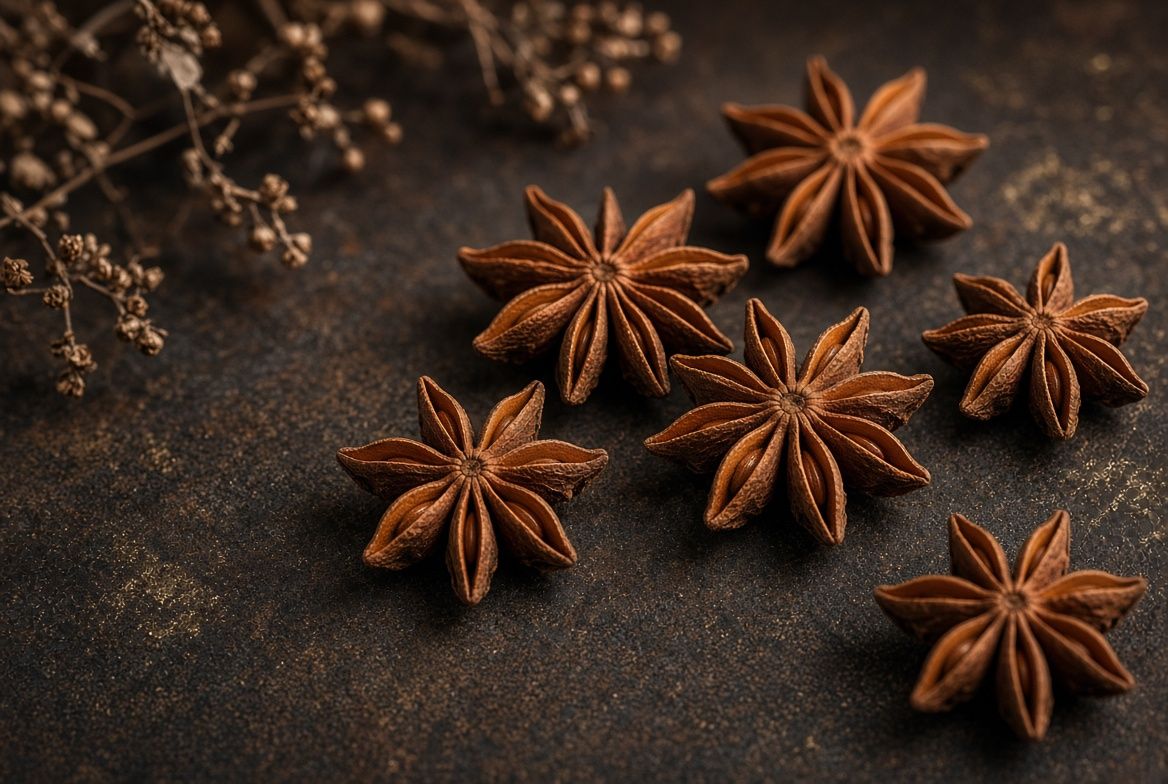
The page describes Illicium verum as an evergreen shrub or small tree with aromatic bark, pointed oval leaves, yellowish-white flowers tinged red or pink, and eight-pointed woody fruits; it states that star anise oil is obtained by steam distillation (Star anise).
The Agroforestry Database profile describes Illicium verum as an evergreen medium-sized tree 8–15 m tall, occasionally reaching 20 m, with a trunk up to 30 cm in diameter. Its aggregate fruit consists of 6–8, rarely 12–13, rather woody, boat-shaped follicles, each containing one seed (Illicium verum).
Cultural History & Traditional Herbalism
Kew describes culinary use of the nearly ripe fruits of Illicium verum as a spice, including in Chinese pork and chicken dishes. These examples document cooking with the fruit, not the infant or ceremonial uses sometimes grouped under the common name (Kew, Plants of the World Online: Illicium verum Hook.f.).
Tradition, Folklore & Symbolism
In Japan, flowering twigs used as cut greenery in cemeteries and Buddhist temples are attributed by PROSEA to Illicium anisatum L., not to the culinary fruit of I. verum Hook.f (Illicium anisatum - PROSEA).
North Carolina State Extension records the use of I. anisatum leaves for incense in Japan. This concerns a different species, plant part and route from culinary use of Chinese star anise (Illicium anisatum (Japanese Anise Tree, Star Anise) | North Carolina Extension Gardener Plant Toolbox).
Kew also mentions bark incense under I. verum, but this does not identify I. verum as the Japanese cemetery or Buddhist temple plant. A generic reference to incense cannot settle the species used in a particular place (Kew, Plants of the World Online: Illicium verum Hook.f.).
Herbal Energetics
Botanical name: Illicium verum Hook. f. Plant part: dried mature fruit. Traditional properties stated: 辛,溫 (pungent, warm). The record also states the functions 散寒、理氣、止痛 (dispel cold, regulate qi, relieve pain) and lists traditional indications, but reports no actual clinical evidence (identified herb record).
These are categories within the named tradition. They are not measurements of body temperature, pharmacological action or clinical efficacy.
InfiniTea sensory metaphor: A compass with a checkpoint. This is original editorial language, not a measured physiological action or a translation of a traditional diagnostic category.
Sensory Profile & Tea Applications
Illicium verum fruit-derived essential oil is described as a clear, colourless or pale yellowish liquid with a characteristic anise-like odour and sweet flavour (Illicium verum Hook.f. - PROSEA - Plant Resources of South East Asia).
The page describes the bark of Illicium verum as aromatic and reports that its seeds are sometimes chewed after meals to sweeten the breath (Star anise).
Sensory notebook: Photograph an authenticated culinary fruit to record its form. Never taste an unknown star-shaped fruit to resolve its identity.
Proposed comparison, not a completed trial: Draw an authenticated culinary fruit and write the species below it. Leave a second, unlabeled outline unresolved rather than assigning it a name by the number of points.
Safety & Responsible Use
A report of seven cases from Miami Children’s Hospital described neurologic reactions in infants aged 2–12 weeks in the Cuban, Central American, and South American population of southern Florida after home administration of tea made by boiling 1–6 star-anise stars in water. The reactions were attributed to an overdose of Chinese star anise (Illicium verum), contamination with Japanese star anise (Illicium anisatum), or both; the article states that star anise tea should not be given to infants. This case series supports avoiding the tea, not calculating an infant dose (Neurotoxicity of Star Anise Tea).
The record identifies Illicium anisatum L. (Japanese star anise) fruits as poisonous and warns that they can be confused with Illicium verum fruits; it recommends using scientific names or the names “Chinese star anise” for I. verum and “Japanese star anise” for I. anisatum (Illicium verum Hook.f. - PROSEA - Plant Resources of South East Asia).
Parents gave star anise herbal tea to two infants younger than 6 months. Reported symptoms included tremors or spasms, hypertonia, hyperexcitability with crying, nystagmus, and vomiting. In one child, Chinese star anise (Illicium verum Hook) was found to be contaminated or adulterated with Japanese star anise (Illicium religiosum), which the article describes as neurotoxic because it contains sesquiterpenic lactones. The article states that star anise products were theoretically prohibited in France from November 2001, but could remain available in some small groceries or be imported by families (Star anise poisoning in infants).
The authors report seven cases of adverse neurologic reactions in infants following home administration of star anise tea. They report evidence that Chinese star anise (Illicium verum) had been contaminated with Japanese star anise (Illicium anisatum), which is associated with neurologic and gastrointestinal toxicity. The authors state that star anise tea should no longer be administered to infants and that stricter federal regulation of star anise imports into the United States is warranted (Neurotoxicities in Infants Seen With the Consumption of Star Anise Tea).
In the two adult cases, tea brewed from star anise was followed by gastrointestinal and neurological symptoms; one patient had a brief tonic-clonic seizure. The article describes prior human reports of neurologic toxicity, including seizures, in infants after star-anise tea consumption, and notes reported adulteration of I. verum with toxic I. anisatum; the two cases in this series were not infants. The article does not report evidence about allergies, pregnancy or lactation, or drug interactions (Case series: star anise toxicity presenting to the emergency department in Eastern Regional Referral Hospital in Bhutan).
Preparation and exposure boundary: This review does not establish a safe medicinal dose in pregnancy, lactation or childhood, or rule out interactions or allergy. Do not substitute essential oil or a concentrated extract for the documented food or herb.
For U.S. food use, the relevant safety determination concerns the intended conditions of use. The existence of a traditional preparation or herbal medicine monograph does not establish that this ingredient, dose and beverage are cleared for sale (Understanding How the FDA Regulates Food Additives and GRAS Ingredients).
Historical Trade, Ecology & Sustainability
The species profile lists China and Vietnam as Illicium verum’s native range, and Jamaica, Laos, and the Philippines as its exotic range (Illicium verum).
Sourcing record: Require an authentication and adulteration-control record that distinguishes culinary I. verum from toxic Illicium species, especially for broken or ground lots.
InfiniTea Herb Lore & Ritualpreliminary draft
Energetics (original InfiniTea metaphor): A compass with a checkpoint. Use this as a private writing image, not a health statement.
For the separately attributed traditional material, see Herbal Energetics; the original sensory image is not a translation of that classification.
Tradition & Folklore: Japanese shikimi is a different, poisonous species. Its documented temple and cemetery use is not an inherited ritual for culinary star anise (Illicium anisatum - PROSEA).
Ritual Cue (original contemporary InfiniTea interpretation): Draw a star with one question at its center: “What tells me this is the right material?” Leave any uncertain point unfilled.
Private preliminary draft; not approved for publication.
Scholarly References & Research Verification
Research limitations
Require authenticated Illicium verum fruit and adulteration controls, especially for broken or powdered material. Do not give star-anise tea to infants or taste uncertain lots.
References below identify the evidence used, not additional endorsements. A botanical authority establishes nomenclature, not the identity of a physical lot. Published study samples, traditional descriptions and InfiniTea proposals are distinguished in the text.
- Kew, Plants of the World Online: Illicium verum Hook.f. | Taxonomic backbone
- Kew, Plants of the World Online: Illicium verum Hook.f. | Taxonomic backbone
- Kew, Plants of the World Online: Illicium anisatum L. | Taxonomic backbone
- Illicium verum Hook.f. - PROSEA - Plant Resources of South East Asia | PROSEA handbook database record on a spice plant
- Star anise | herbal ingredient information webpage
- Illicium verum | species profile
- Neurotoxicity of Star Anise Tea | clinical case series report with commentary
- Star anise poisoning in infants | Case reports: two infant cases, reported in an English abstract; article is in French.
- Neurotoxicities in Infants Seen With the Consumption of Star Anise Tea | A 2004 journal article reporting infant cases associated with star anise tea.
- Case series: star anise toxicity presenting to the emergency department in Eastern Regional Referral Hospital in Bhutan | A two-patient case series describing suspected star anise toxicity after brewed-tea consumption in adults in Bhutan. The article also discusses previously published pediatric reports and reports associating toxicity with Japanese star anise (Illicium anisatum) mixed with Chinese star anise (Illicium verum).
- identified herb record | Hong Kong Baptist University Chinese Medicinal Materials Image Database record; no named classical tradition is specified.
- Illicium anisatum - PROSEA | PROSEA Handbook 12(2): Medicinal and poisonous plants 2; botanical and medicinal-plant record, number 1216.
- Illicium anisatum (Japanese Anise Tree, Star Anise) | North Carolina Extension Gardener Plant Toolbox | Evidence from the supplied North Carolina Extension Gardener Plant Toolbox page.
- Understanding How the FDA Regulates Food Additives and GRAS Ingredients | U.S. FDA consumer-information webpage describing food-additive and GRAS ingredient oversight.
Final Botanical Summary
The distinction from aniseed is botanical; the distinction from Japanese star anise is safety-critical. Both belong on the first page of a research record.
Editorial disposition: Identity hold. The report is a private reference, not a clinical recommendation, approval for sale or authenticated sensory trial.
Verification Status (November 2026)
Phase II source audit, claim by claim
- Claims checked
- 17
- Corrected
- 1
- Withheld
- 9
- Sources
- 14
Identity hold: the species, plant part or market name still needs confirming before any product decision. See Identity and the research limitations.
Citation check: All 6 Safety & Use citations were re-read against their sources in November 2026 and confirmed.
A private research reference, not a clinical recommendation or product claim. Checked to the Grimoire's research standards →