
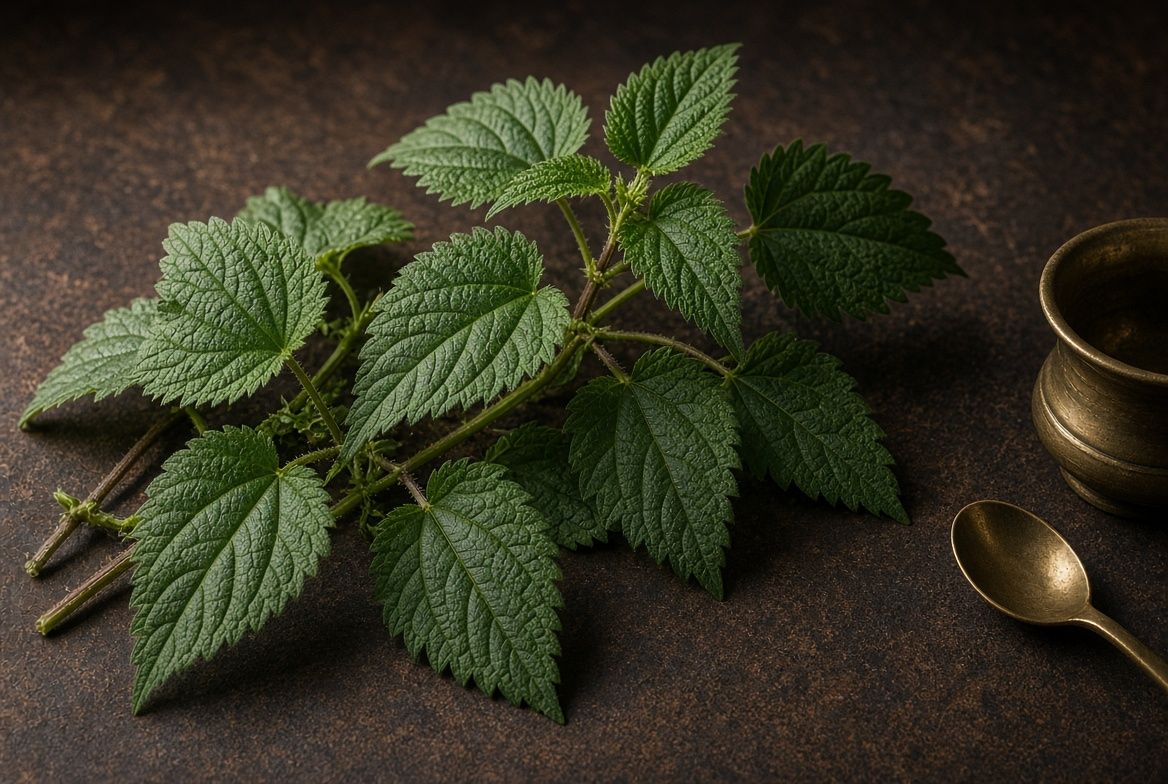
Botanical Identity & Classification
Inventory scope: Urtica dioica · Urticaceae · leaf or aerial herb, provisional.
Nomenclatural check: Urtica dioica L. is accepted in this treatment (family Urticaceae). A synonym listed there is Urtica dioica var. vulgaris Wedd. The stated native range is Europe to Siberia and W. China, NW. Africa (Kew, Plants of the World Online: Urtica dioica L.).
Inventory decision: Specify leaf versus root and handling or processing. Root preparations studied for urinary symptoms are not evidence about drinking nettle leaf; do not taste fresh stinging tissue.
The page identifies stinging nettle as Urtica dioica L. (Urticaceae) (Urtica dioica - Oxford University Plants 400).
The report defines nettle leaf as the whole or cut, dried leaves of Urtica dioica L. or Urtica urens L., or a mixture of those species; it also cites a definition that includes their hybrids or mixtures (Assessment report on Urtica dioica L., Urtica urens L., folium).
The report concerns the dried aerial parts (herba) of Urtica dioica L. and Urtica urens L., rather than separate leaf or root preparations. It supports traditional-use indications for relief of symptoms associated with minor urinary complaints (with sufficient fluid intake), relief of minor articular pain, and use of powdered herb in seborrhoeic skin conditions; the human studies described were open studies, and the report concludes that clinical efficacy evidence is inconclusive (Assessment report on Urtica dioica L.; Urtica urens L., herba).
Botanical & Scientific Profile
The stinging structures of fresh plants, the prepared aerial herb and the medicinal root answer different safety questions. A root monograph is not a stand-in for leaf tea.
A double-blind clinical trial of Urtica dioica root extract enrolled 74 patients with allergic rhinitis, divided between placebo and 150 mg extract daily for one month. Among the 40 patients assessed with the sino-nasal outcome test, symptoms improved in both groups, while the extract group had a significant decrease in mean nasal-smear eosinophil count. The review states that more clinical studies are needed to validate U. dioica’s efficacy (Stinging Nettle (Urtica dioica L.): Nutritional Composition, Bioactive Compounds, and Food Functional Properties).
In a randomized, controlled, double-blind crossover study of 27 people with osteoarthritic pain at the base of the thumb or index finger, participants applied fresh Urtica dioica leaves to the painful area daily for one week. Pain and disability score reductions were significantly greater than with placebo; the report notes the small sample and incomplete blinding (Assessment report on Urtica dioica L., Urtica urens L., folium).
The page states that the silica-rich walls at the tips of Urtica dioica’s bristles break easily on touch, leaving a hypodermic-like needle through which histamine, acetylcholine, and “5-hydroxtryptamine” are released (Urtica dioica - Oxford University Plants 400).
Cultural History & Traditional Herbalism
Nettle-fibre cloth was used to wrap the cremated remains of a man found in a Bronze Age burial mound on Funen, Denmark. Strontium-isotope analysis of the fibres indicated that the nettles may have come from Sweden, Norway, or Central Europe; the bronze urn’s Central European style further supported a possible nonlocal origin (No sting in this tale).
In Micrographia (1665), Oxford-educated Robert Hooke described Urtica dioica’s stinging points and juice, observing a bristle-like “syringe-pipe” with a small “bagg” at its base and speculating that the bag contained “corrosive penetrant liquor.” (Urtica dioica - Oxford University Plants 400).
The review reports that Urtica dioica has been used for centuries as food and traditional medicine and is known as Sisnu in Nepal (Stinging Nettle (Urtica dioica L.): Nutritional Composition, Bioactive Compounds, and Food Functional Properties).
The account states that boiled leaves of Urtica dioica are edible and can be substituted for spinach, citing references [1] and [11]. It does not identify a European community, date, or specific historical practice for eating the leaves (Urtica dioica - US Forest Service).
Tradition, Folklore & Symbolism
No separate inherited symbolic or ceremonial use of this identified part was established here. A documented food, trade or medicinal practice should remain under its own description rather than being relabeled as ritual.
Herbal Energetics
Insufficient documented evidence for a traditional energetic classification. No temperature, direction or channel is inferred from the flavor of a cup.
InfiniTea sensory metaphor: Changing how one approaches. This is original editorial language, not a measured physiological action or a translation of a traditional diagnostic category.
Sensory Profile & Tea Applications
The report provides no description of nettle leaf aroma or taste. It describes a clinical study in which participants ate 50 g of stewed Urtica dioica leaf purée, and cites a source saying that American plant forager and naturalist Euell Gibbons recommended nettle leaves as nutritious food (Assessment report on Urtica dioica L., Urtica urens L., folium).
The review reports that Urtica dioica leaves and stalks are eaten as salad or vegetables and are used to prepare tea. In remote hilly regions of Nepal and India, people collect tender shoots and leaves and cook them as vegetables or soup; the plant is also boiled with maize, millet, or wheat flour, salt, and chili to make porridge (Stinging Nettle (Urtica dioica L.): Nutritional Composition, Bioactive Compounds, and Food Functional Properties).
Sensory notebook: Describe dried, food-grade leaf and a reliably processed infusion rather than handling raw hairs. Record a green or broth-like impression only if observed.
Proposed comparison, not a completed trial: Use a labeled dried specimen or photograph. Note leaf margins and stem fragments without rubbing fresh tissue on skin as a test.
For ordinary dried herbal or fruit infusions, the German Federal Institute for Risk Assessment advises using boiling water and not leaving the prepared infusion standing for hours. Cooling a hot infusion and steeping untreated dry material in cold water are different processes; this report does not validate the latter (Boiling water a must for herbal teas).
Safety & Responsible Use
The EMA/HMPC assessment report states that preparations of Urtica dioica L. and Urtica urens L. herba are not recommended for people with conditions for which a medical doctor advises reduced fluid intake, because adequate fluid intake is required during use for minor urinary complaints (Assessment report on Urtica dioica L.; Urtica urens L., herba).
The report states that safety of nettle leaf preparations during pregnancy and lactation has not been established and that use during those periods is not recommended because data are insufficient. Its listed monograph contraindication is hypersensitivity to nettle herb; this is not stated specifically as a leaf- or root-preparation contraindication (Assessment report on Urtica dioica L., Urtica urens L., folium).
Reports describe occasional allergic reactions and other effects after nettle tea, including cutaneous affections, oedema, oliguria and gastric irritation; the monograph lists nausea, vomiting, diarrhoea, allergic pruritus, rash and urticaria with frequency not known. The 32-person study reported some cases of diarrhoea, while the 114-person study reported one nausea case considered unrelated to treatment; hypersensitivity to the active substance is a contraindication, and nettle herb is not recommended when reduced fluid intake is advised. Pregnancy and lactation safety has not been established and use is not recommended: the report notes that nettle is reputed to be abortifacient and that utero-activity was documented in animal studies, but states that fertility data are unavailable (Assessment report on Urtica dioica L.; Urtica urens L., herba).
Preparation and exposure boundary: This review does not establish a safe medicinal dose in pregnancy, lactation or childhood, or rule out interactions or allergy. Do not substitute essential oil or a concentrated extract for the documented food or herb.
For U.S. food use, the relevant safety determination concerns the intended conditions of use. The existence of a traditional preparation or herbal medicine monograph does not establish that this ingredient, dose and beverage are cleared for sale (Understanding How the FDA Regulates Food Additives and GRAS Ingredients).
Historical Trade, Ecology & Sustainability
The page says Urtica dioica has been found around human settlements since at least the Neolithic; its frequency in pollen cores implies it is native to the UK, though its association with human activity may indicate introduction across at least part of its range (Urtica dioica - Oxford University Plants 400).
The review reports that Urtica dioica occurs in temperate regions of Asia, Europe, North Africa, and North America, up to 1,800 m altitude. In Nepal, it is reported from moist areas at about 500–4,500 m altitude (Stinging Nettle (Urtica dioica L.): Nutritional Composition, Bioactive Compounds, and Food Functional Properties).
The first formal UK record of Urtica dioica was in 1562, but its distribution before systematic species recording in the twentieth century is difficult to determine. The page also notes nettle patches marking phosphate-rich debris at long-deserted villages and human-occupation sites more than 1,500 years old (Urtica dioica - Oxford University Plants 400).
Sourcing record: Identify leaf versus whole herb, verify controlled collection and drying, and keep root-harvest impacts separate from leaf collection.
InfiniTea Herb Lore & Ritualpreliminary draft
Energetics (original InfiniTea metaphor): Changing how one approaches. Use this as a private writing image, not a health statement.
Tradition & Folklore: The account states that boiled leaves of Urtica dioica are edible and can be substituted for spinach, citing references [1] and [11]. It does not identify a European community, date, or specific historical practice for eating the leaves (Urtica dioica - US Forest Service). This is a record of use, not a claim of inherited ritual.
Ritual Cue (original contemporary InfiniTea interpretation): Write about a task that became manageable when you changed the way you handled it.
Private preliminary draft; not approved for publication.
Scholarly References & Research Verification
Research limitations
Confirm organ and processing before use; avoid bare-skin identification of fresh nettle. Check which species a mixed-species medicinal monograph actually covers.
References below identify the evidence used, not additional endorsements. A botanical authority establishes nomenclature, not the identity of a physical lot. Published study samples, traditional descriptions and InfiniTea proposals are distinguished in the text.
- Kew, Plants of the World Online: Urtica dioica L. | Taxonomic backbone
- Urtica dioica - Oxford University Plants 400 | botanical species profile webpage
- Assessment report on Urtica dioica L., Urtica urens L., folium | EMA regulatory assessment report
- Stinging Nettle (Urtica dioica L.): Nutritional Composition, Bioactive Compounds, and Food Functional Properties | review article
- No sting in this tale | archaeological news article excerpt
- Assessment report on Urtica dioica L.; Urtica urens L., herba | EMA/HMPC assessment report
- Urtica dioica - US Forest Service | Fire Effects Information System species account, authored by Jennifer H. Carey (1995).
- Boiling water a must for herbal teas | BfR press release providing general food-safety guidance for preparing herbal and fruit infusions.
- Understanding How the FDA Regulates Food Additives and GRAS Ingredients | U.S. FDA consumer-information webpage describing food-additive and GRAS ingredient oversight.
Final Botanical Summary
The same plant can supply a fiber, cooked green and medicinal raw material. Those histories belong together, but routes and parts must remain labeled.
Editorial disposition: Lot unverified. The report is a private reference, not a clinical recommendation, approval for sale or authenticated sensory trial.
Verification Status (November 2026)
Phase II source audit, claim by claim
- Claims checked
- 15
- Corrected
- 4
- Withheld
- 0
- Sources
- 9
Material: Lot unverified. No physical sample has been examined.
Citation check: All 4 Safety & Use citations were re-read against their sources in November 2026 and confirmed.
A private research reference, not a clinical recommendation or product claim. Checked to the Grimoire's research standards →