
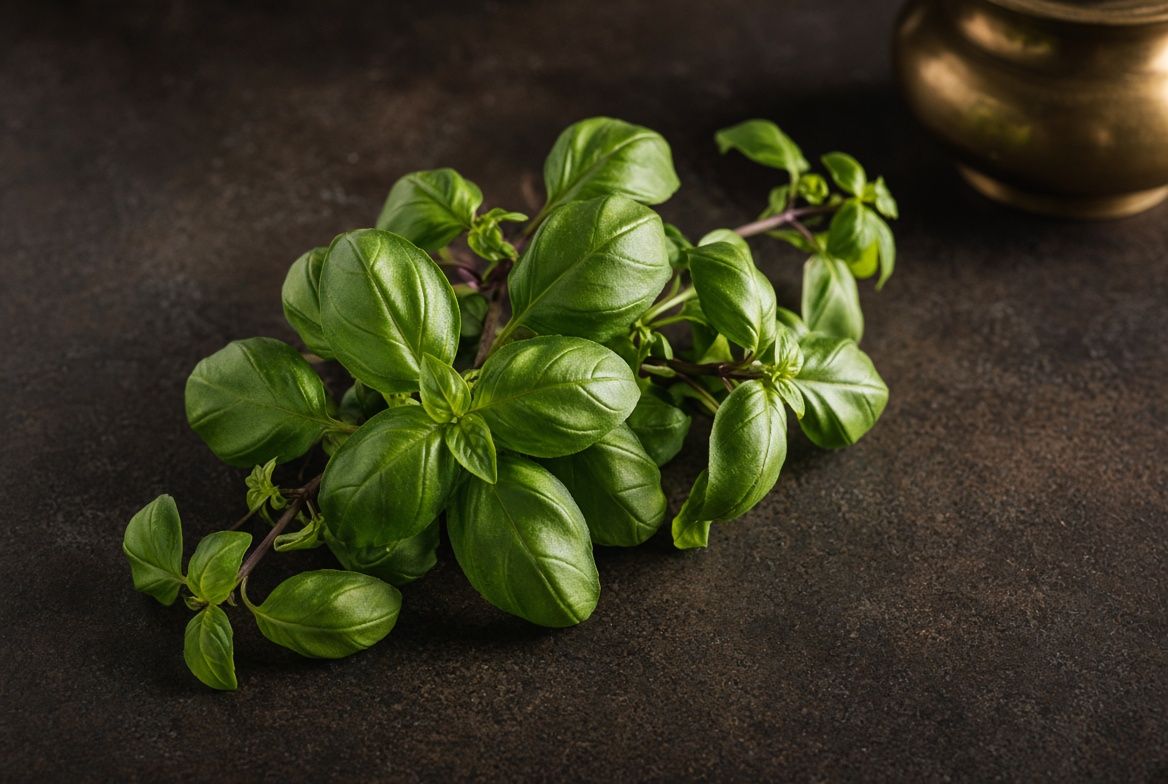
Botanical Identity & Classification
Inventory scope: Ocimum basilicum · Lamiaceae · leaf.
Nomenclatural check: Ocimum basilicum L. is accepted in this treatment (family Lamiaceae). A synonym listed there is Ocimum odorum Salisb. in Prodr. Stirp. Chap. Allerton: 87 (1796), nom. superfl. The stated native range is Tropical & Subtropical Asia to N. Australia (Kew, Plants of the World Online: Ocimum basilicum L.).
Comparison taxon; not a substitute: Ocimum tenuiflorum L. is accepted in this treatment (family Lamiaceae). A synonym listed there is Ocimum sanctum L. The stated native range is Tropical & Subtropical Asia to W. Pacific (Kew, Plants of the World Online: Ocimum tenuiflorum L.).
Inventory decision: Specify sweet basil and cultivar if known; do not borrow the devotional history of tulsi. Culinary leaf and a concentrated essential oil are not equivalent exposures.
The article identifies sweet basil as Ocimum basilicum in the Lamiaceae, or mint, family (Herb Garden Plants: Basil).
Sweet basil, Ocimum basilicum L., belongs to the Lamiaceae (Labiatae) family and is described as an annual herb with dense, aromatic foliage (Sweet Basil (Ocimum basilicum L.)―A Review of Its Botany, Phytochemistry, Pharmacological Activities, and Biotechnological Development).
Botanical & Scientific Profile
Sweet basil belongs in a culinary and cultivar-specific account. To describe tulsi's place in Hindu practice, cross-reference the holy-basil record instead of giving that tradition to the leaf used in pesto.
A clinical case in the review describes a hydrogel combining Ocimum basilicum L. and Trifolium pratense extracts that was applied twice daily to a patient with psoriasis vulgaris; erythema symptoms decreased within one week. The review states that further investigation and clinical trials are needed to develop natural medicines from O. basilicum (Sweet Basil (Ocimum basilicum L.)―A Review of Its Botany, Phytochemistry, Pharmacological Activities, and Biotechnological Development).
The article describes Ocimum basilicum leaves as opposite, ovate, and green to purple; its stems as square; its white, two-lipped flowers as growing on spikes in terminal racemes; and its fruits as dark brown nutlets (Herb Garden Plants: Basil).
Ocimum basilicum L. can grow up to 0.6 m tall and has a round-to-quadrangular stem. Its chemical constituents are dominated by phenylpropanoid and monoterpenoid classes; reported constituents include linalool, eugenol, estragole, and 1,8-cineole (eucalyptol) (Sweet Basil (Ocimum basilicum L.)―A Review of Its Botany, Phytochemistry, Pharmacological Activities, and Biotechnological Development).
Cultural History & Traditional Herbalism
Ethnomedicinal accounts report that Tetun people in East Nusa Tenggara, Indonesia, consume fresh, raw Ocimum basilicum L. leaves for malaria; the Batak Karo people of North Sumatra use the plant for rheumatism, high cholesterol, hypertension, headaches, and stroke; and the Muna Tribe of Southeast Sulawesi uses its leaves as an anti-helminthic remedy (Sweet Basil (Ocimum basilicum L.)―A Review of Its Botany, Phytochemistry, Pharmacological Activities, and Biotechnological Development).
The article’s introduction describes basil (Ocimum spp.) as a popular culinary herb in the United States and worldwide, and states that basil is widely used in fragrance, culinary, and pharmaceutical applications. It gives no specific historical date or named cultural tradition for these uses (Relationship between sensory perceptions and volatile and phenolic compounds of fresh basil (Ocimum basilicum L.) evaluated by multivariate statistics).
The review identifies Ocimum basilicum L. as the basil used in traditional uncooked Ligurian pesto alla Genovese, prepared by blending fresh leaves with olive oil, pine nuts, garlic, salt, and aged cheeses. It describes ‘Basilico Genovese’ as a Protected Designation of Origin product recognized by the European Union under Regulation No. 611/2010, and reports that the traditional and prevalent cultivar in the Riviera Ligure is ‘Genovese Gigante’. These details are presented in a review of literature and production specifications; the article provides no dated account of the sauce’s origins or direct historical evidence of its use (Sweet Basil Raw Material Functionality as a Framework for Industrial Pesto Quality: A Field-to-Fork Perspective).
Tradition, Folklore & Symbolism
Hindu accounts of tulsi as a sacred plant refer to holy basil, Ocimum tenuiflorum. They should not be used to describe ordinary culinary sweet basil (Holy basil | Description, Uses, Tulsi, Hinduism, & Facts).
A documented context for sweet basil itself is Ligurian pesto, made with Ocimum basilicum. A regional culinary association is not evidence of a sacred rite (Sweet Basil Raw Material Functionality as a Framework for Industrial Pesto Quality: A Field-to-Fork Perspective).
Herbal Energetics
Insufficient documented evidence for a traditional energetic classification. No temperature, direction or channel is inferred from the flavor of a cup.
InfiniTea sensory metaphor: Freshness at hand. This is original editorial language, not a measured physiological action or a translation of a traditional diagnostic category.
Sensory Profile & Tea Applications
The article states that sweet basil’s essential oil contains methyl chavicol (estragole) and linalool, which impart a sweet taste and floral scent (Herb Garden Plants: Basil).
Ocimum basilicum L. is described as an aromatic herb traditionally used for culinary and perfumery purposes; the review does not specify its taste or flavor profile (Sweet Basil (Ocimum basilicum L.)―A Review of Its Botany, Phytochemistry, Pharmacological Activities, and Biotechnological Development).
Sensory notebook: Compare two labeled cultivars for green, clove-like or anise-like impressions. Tie each adjective to the sample instead of declaring a universal basil flavor.
Proposed comparison, not a completed trial: Compare two identified culinary cultivars under their own names. Ask which aroma persists after the leaves are torn, without borrowing sacred vocabulary for a sensory judgment.
For ordinary dried herbal or fruit infusions, the German Federal Institute for Risk Assessment advises using boiling water and not leaving the prepared infusion standing for hours. Cooling a hot infusion and steeping untreated dry material in cold water are different processes; this report does not validate the latter (Boiling water a must for herbal teas).
Safety & Responsible Use
The HMPC statement evaluates estragole exposure from herbal medicinal products, including fennel-fruit preparations, and reviews toxicological evidence from animal studies in mice and rats, laboratory studies, and human metabolism studies. It discusses dietary exposure and plant mixtures, but makes no specific conclusion about seasoning an ordinary meal with a few basil leaves (Public statement on the use of herbal medicinal products containing estragole).
The review reports variation in Ocimum basilicum L. essential-oil composition: it describes five chemotypes and notes that chemical composition and antibacterial activity can vary among regions in Saudi Arabia, with composition influenced by agro-climatic conditions (Sweet Basil (Ocimum basilicum L.)―A Review of Its Botany, Phytochemistry, Pharmacological Activities, and Biotechnological Development).
The statement reports no data on reproductive toxicity or teratogenicity; pregnant and breastfeeding women are identified as sensitive groups under the general estragole precautions, not on the basis of basil-specific pregnancy or lactation evidence. Basil oil containing 88% estragole induced UDS in the same dose range as estragole in a UDS test; separately, nevadensin inhibited estragole bioactivation in vitro, and rat co-administration at a basil-reflective ratio suggested less bioactivation than with pure estragole, although the statement says the matrix effect remains debatable (Public statement on the use of herbal medicinal products containing estragole).
Preparation and exposure boundary: This review does not establish a safe medicinal dose in pregnancy, lactation or childhood, or rule out interactions or allergy. Do not substitute essential oil or a concentrated extract for the documented food or herb.
For U.S. food use, the relevant safety determination concerns the intended conditions of use. The existence of a traditional preparation or herbal medicine monograph does not establish that this ingredient, dose and beverage are cleared for sale (Understanding How the FDA Regulates Food Additives and GRAS Ingredients).
Historical Trade, Ecology & Sustainability
Ocimum basilicum L. is extensively cultivated in Indonesia, India, Morocco, France, Hungary, Greece, and Egypt; the review also identifies Egypt, India, Indonesia, Mexico, and the United States as commercial producers (Sweet Basil (Ocimum basilicum L.)―A Review of Its Botany, Phytochemistry, Pharmacological Activities, and Biotechnological Development).
The genus Ocimum is distributed across tropical and subtropical regions of the Americas, Africa, and Asia, and Ocimum basilicum L. is described as likely native to Asia and Africa (Sweet Basil (Ocimum basilicum L.)―A Review of Its Botany, Phytochemistry, Pharmacological Activities, and Biotechnological Development).
Sourcing record: Track cultivar or chemotype if supplied and keep sweet basil separate from tulsi in purchasing and cultural attribution.
InfiniTea Herb Lore & Ritualpreliminary draft
Energetics (original InfiniTea metaphor): Freshness at hand. Use this as a private writing image, not a health statement.
Tradition & Folklore: A documented context for sweet basil itself is Ligurian pesto, made with Ocimum basilicum. A regional culinary association is not evidence of a sacred rite (Sweet Basil Raw Material Functionality as a Framework for Industrial Pesto Quality: A Field-to-Fork Perspective).
Ritual Cue (original contemporary InfiniTea interpretation): Sketch a leaf beside the name of an everyday meal. Note the person or place that taught you to make it.
Private preliminary draft; not approved for publication.
Scholarly References & Research Verification
Research limitations
Check cultivar and chemotype when comparing aroma or oil studies. A common-name statement about “basil” does not resolve species, ceremony or pharmacological exposure.
References below identify the evidence used, not additional endorsements. A botanical authority establishes nomenclature, not the identity of a physical lot. Published study samples, traditional descriptions and InfiniTea proposals are distinguished in the text.
- Kew, Plants of the World Online: Ocimum basilicum L. | Taxonomic backbone
- Kew, Plants of the World Online: Ocimum tenuiflorum L. | Taxonomic backbone
- Herb Garden Plants: Basil | horticultural plant guide
- Sweet Basil (Ocimum basilicum L.)―A Review of Its Botany, Phytochemistry, Pharmacological Activities, and Biotechnological Development | review article based on a literature survey; 156 publications were evaluated
- Relationship between sensory perceptions and volatile and phenolic compounds of fresh basil (Ocimum basilicum L.) evaluated by multivariate statistics | study
- Public statement on the use of herbal medicinal products containing estragole | Regulatory public statement and toxicological evidence review
- Sweet Basil Raw Material Functionality as a Framework for Industrial Pesto Quality: A Field-to-Fork Perspective | Classical narrative review of sweet basil production, postharvest handling, industrial pesto processing, and quality.
- Holy basil | Description, Uses, Tulsi, Hinduism, & Facts | Britannica descriptive article on holy basil and Hindu religious practices
- Boiling water a must for herbal teas | BfR press release providing general food-safety guidance for preparing herbal and fruit infusions.
- Understanding How the FDA Regulates Food Additives and GRAS Ingredients | U.S. FDA consumer-information webpage describing food-additive and GRAS ingredient oversight.
Final Botanical Summary
Cultivar and chemistry matter even within one species. A sensible sensory entry is more precise than a generic promise about basil oil.
Editorial disposition: Lot unverified. The report is a private reference, not a clinical recommendation, approval for sale or authenticated sensory trial.
Verification Status (November 2026)
Phase II source audit, claim by claim
- Claims checked
- 15
- Corrected
- 2
- Withheld
- 2
- Sources
- 10
Material: Lot unverified. No physical sample has been examined.
Citation check: All 4 Safety & Use citations were re-read against their sources in November 2026 and confirmed.
A private research reference, not a clinical recommendation or product claim. Checked to the Grimoire's research standards →