
Botanical Identity & Classification
Inventory scope: Curcuma longa · Zingiberaceae · rhizome.
Nomenclatural check: Curcuma longa L. is accepted in this treatment (family Zingiberaceae). A synonym listed there is Curcuma domestica Valeton. The stated native range is Cultigen from SW. India (Kew, Plants of the World Online: Curcuma longa L.).
Inventory decision: Separate culinary rhizome from curcumin isolates and absorption-enhanced supplements. The color of an infusion is not an assay of curcumin exposure.
The article identifies turmeric as Curcuma longa L. in the ginger family, Zingiberaceae (Ethnobotany of turmeric (Curcuma longa L.)).
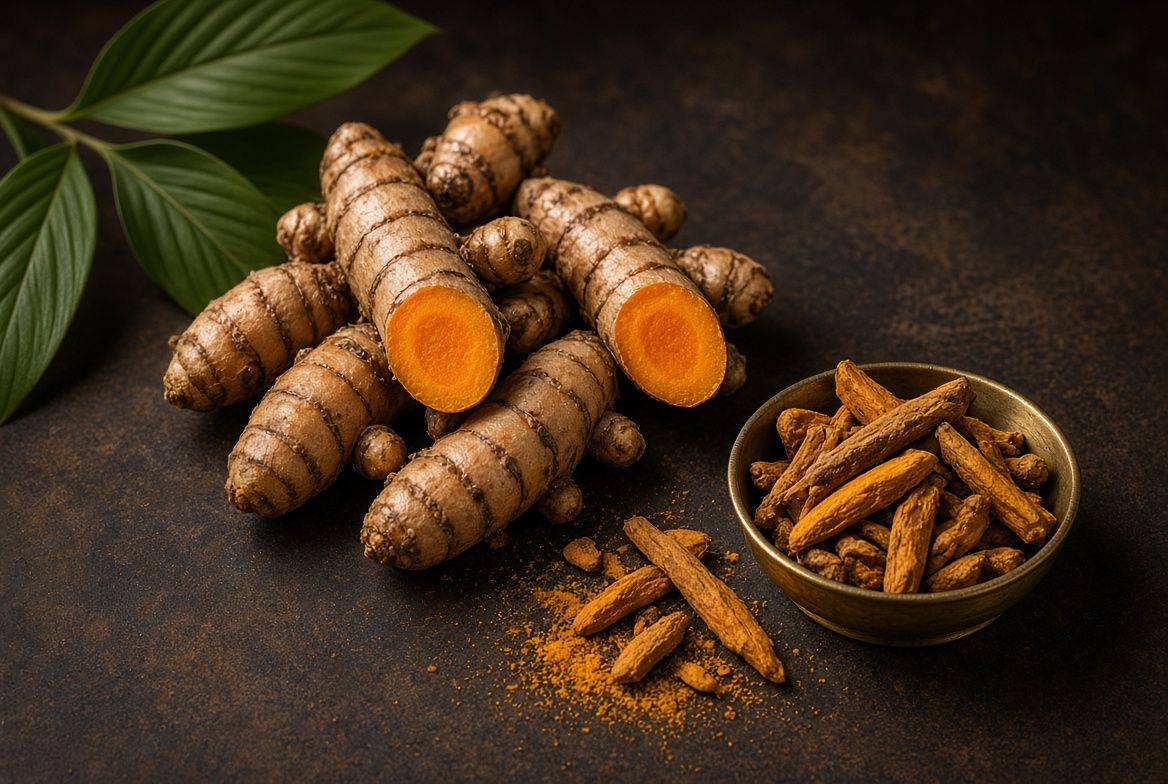
Turmeric (Curcuma longa) is a perennial herbaceous member of the Zingiberaceae family. Its thick, fleshy underground stems, or rhizomes, are the plant part harvested and processed into turmeric powder (Turmeric: A Comprehensive Review of Its Botany, Traditional Uses, Phytochemistry, and Mechanisms as a Functional Food).
Botanical & Scientific Profile
Separate turmeric rhizome as food from concentrated curcuminoid supplements and products designed for increased absorption. A safety signal for one formulation should neither condemn the culinary spice nor excuse the supplement.
Clinical trials of bioavailable turmeric extracts in people with knee osteoarthritis report reduced pain and stiffness and lower inflammatory biomarkers, including C-reactive protein and TNF-α. Meta-analyses report pain and inflammation reductions comparable to paracetamol, with fewer adverse effects. Differences in formulations, doses, treatment durations, and outcome measures complicate comparisons and synthesis of clinical findings (Turmeric: A Comprehensive Review of Its Botany, Traditional Uses, Phytochemistry, and Mechanisms as a Functional Food).
Kew describes turmeric (Curcuma longa) as an upright herb with large oblong leaves, dark green above and pale green underneath; yellow-white flowers on spike-like stalks with small brown seeds; and thick, ringed underground rhizomes through which the plant reproduces (Turmeric - Curcuma longa | Plants - Kew Gardens).
The article reports that turmeric rhizomes contain curcumin, oleoresin, oil, and other complex chemical constituents (Ethnobotany of turmeric (Curcuma longa L.)).
Cultural History & Traditional Herbalism
Kew states that people in India have used turmeric (Curcuma longa) for at least 2,500 years, and that it has played a key role for thousands of years in dishes, medicinal remedies, and cultural practices (Turmeric - Curcuma longa | Plants - Kew Gardens).
The authors present South Asia as the crop’s origin and early-domestication region, say turmeric’s history in India may predate the Indus Valley civilization, and discuss the Vedic period as probably about 4,000 years ago; separately, they state that turmeric cultivation or gathering in India began much earlier, without dating that start specifically to the Vedic period (Ethnobotany of turmeric (Curcuma longa L.)).
Turmeric has a long history as a culinary spice and medicinal agent in Asian cultures, including India, China, and Southeast Asia; the review gives no specific historical date for this use (Turmeric: A Comprehensive Review of Its Botany, Traditional Uses, Phytochemistry, and Mechanisms as a Functional Food).
The record says turmeric is used in Ayurveda, a traditional medicine system in India, to treat worms, gallstones, flatulence, arthritis, and menstrual problems, and to improve digestion and energy; it attributes this account to Prasad and Aggarwal (2011). It reports that the rhizome is used as a spice and dye in Asian dishes, including curry powder, and that harvested rhizomes are boiled and sun-dried for about a week before use, though they may also be used fresh (Curcuma longa L.).
Tradition, Folklore & Symbolism
The review describes turmeric as part of religious rituals and social customs in diverse cultures, but does not specify a particular ritual, story, or symbolism (Turmeric: A Comprehensive Review of Its Botany, Traditional Uses, Phytochemistry, and Mechanisms as a Functional Food).
The NCCIH page reports that turmeric (listed as Curcuma longa) has been used in some Indian religious ceremonies; it does not specify which plant part was used (Turmeric: Usefulness and Safety).
Herbal Energetics
In its discussion of Ayurveda, the article describes turmeric as bitter, pungent, and astringent, and says it has a healing and cooling effect on the body (Ethnobotany of turmeric (Curcuma longa L.)).
Taxon: Curcuma longa L. Organ: dried rhizome. Tradition: Chinese materia medica. Stated properties (性味): acrid (辛), bitter (苦), warm (溫) (薑黃 (Jianghuang) — Common Turmeric Rhizome).
These are categories within the named tradition. They are not measurements of body temperature, pharmacological action or clinical efficacy.
InfiniTea sensory metaphor: A mark that stays. This is original editorial language, not a measured physiological action or a translation of a traditional diagnostic category.
Sensory Profile & Tea Applications
Kew describes turmeric (Curcuma longa) powder as warm and bitter like black pepper, with an earthy, mustard-like aroma (Turmeric - Curcuma longa | Plants - Kew Gardens).
The article says turmeric rhizome is used as a condiment and spice that adds color, flavor, and taste to dishes; it also mentions coloring biriyani, a rice dish prepared with meat (Ethnobotany of turmeric (Curcuma longa L.)).
Sensory notebook: Compare suspended powder and strained liquor for opacity, color and sediment. Do not infer that the clearer cup has no flavor or the darker cup has clinical potency.
Proposed comparison, not a completed trial: Observe color in a filtered liquid and in the settled powder separately. Do not treat a darker suspension as evidence of higher absorption.
For ordinary dried herbal or fruit infusions, the German Federal Institute for Risk Assessment advises using boiling water and not leaving the prepared infusion standing for hours. Cooling a hot infusion and steeping untreated dry material in cold water are different processes; this report does not validate the latter (Boiling water a must for herbal teas).
Safety & Responsible Use
The NCCIH page reports liver damage in some people who consumed curcumin products with increased bioavailability. For turmeric or curcumin products, it advises stopping use immediately and contacting a health care provider if symptoms such as fatigue, nausea, poor appetite, dark urine, or jaundice occur (Turmeric: Usefulness and Safety).
The NCCIH page states that turmeric (Curcuma longa) supplements during pregnancy may be unsafe, and that little is known about the safety of using turmeric in amounts greater than those commonly found in food while breastfeeding (Turmeric: Usefulness and Safety).
The review reports more than 30 published case reports and several case series of clinically apparent liver injury associated with oral turmeric- or curcuminoid-containing products; injury typically appeared after 1–4 months and generally improved after the product was stopped, although rare acute liver failure was reported. Piperine or black pepper was present in many reported products, but the review describes the proposed role of enhanced bioavailability as uncertain; it notes that LiverTox recognizes turmeric as a well-documented cause of herbal-related liver injury in the United States and assigns it a likelihood score of A (Rarely reported cases of hepatotoxicity associated with turmeric- and curcuminoid-containing dietary supplements: a comprehensive review by USP).
Liver damage has been reported in people who consumed curcumin products with increased bioavailability; the page cites a human DILIN report of ten liver-injury cases associated with turmeric, but does not identify the exact products or establish that all turmeric or curcumin preparations carry the same risk. Oral turmeric can cause nausea, vomiting, acid reflux, stomach upset, diarrhea, or constipation, and topical curcumin can cause hives or itching; turmeric supplements during pregnancy may be unsafe, while safety of amounts above those commonly found in food during breastfeeding is little known (Turmeric: Usefulness and Safety).
Preparation and exposure boundary: This review does not establish a safe medicinal dose in pregnancy, lactation or childhood, or rule out interactions or allergy. Do not substitute essential oil or a concentrated extract for the documented food or herb.
For U.S. food use, the relevant safety determination concerns the intended conditions of use. The existence of a traditional preparation or herbal medicine monograph does not establish that this ingredient, dose and beverage are cleared for sale (Understanding How the FDA Regulates Food Additives and GRAS Ingredients).
Historical Trade, Ecology & Sustainability
The article reports that India produces 93.7% of the world’s turmeric and cultivates it on 150,000 hectares. It lists the states with the largest area in this order: Andhra Pradesh, Maharashtra, Tamil Nadu, Orissa, Karnataka, and Kerala; it says about 92% of produce is consumed domestically and 8% is exported annually (Ethnobotany of turmeric (Curcuma longa L.)).
The NCCIH page states that turmeric (Curcuma longa) is grown commercially in Southeast Asia and India (Turmeric: Usefulness and Safety).
Kew states that turmeric (Curcuma longa) is domesticated, widely cultivated throughout the tropics, and not known to grow in the wild. In temperate regions, it is described as a cultivated plant grown indoors or in heated greenhouses at a minimum temperature of 18°C. The page identifies India as the world’s largest producer, consumer, and exporter of turmeric (Turmeric - Curcuma longa | Plants - Kew Gardens).
Sourcing record: Ask for traceable rhizome and screening for adulteration in powdered lots; a bright yellow powder is not self-authenticating.
InfiniTea Herb Lore & Ritualpreliminary draft
Energetics (original InfiniTea metaphor): A mark that stays. Use this as a private writing image, not a health statement.
For the separately attributed traditional material, see Herbal Energetics; the original sensory image is not a translation of that classification.
Tradition & Folklore: The review describes turmeric as part of religious rituals and social customs in diverse cultures, but does not specify a particular ritual, story, or symbolism (Turmeric: A Comprehensive Review of Its Botany, Traditional Uses, Phytochemistry, and Mechanisms as a Functional Food).
Ritual Cue (original contemporary InfiniTea interpretation): Write one brief lesson you hope will leave a lasting mark. No coloring of the skin or imitation of a ceremony is needed.
Private preliminary draft; not approved for publication.
Scholarly References & Research Verification
Research limitations
Record the actual product, added piperine or other delivery technology, timing and co-ingredients when evaluating liver injury reports.
Published cases often had co-medications or other confounders and incomplete product characterization, limiting causal assessment (Rarely reported cases of hepatotoxicity associated with turmeric- and curcuminoid-containing dietary supplements: a comprehensive review by USP).
References below identify the evidence used, not additional endorsements. A botanical authority establishes nomenclature, not the identity of a physical lot. Published study samples, traditional descriptions and InfiniTea proposals are distinguished in the text.
- Kew, Plants of the World Online: Curcuma longa L. | Taxonomic backbone
- Ethnobotany of turmeric (Curcuma longa L.) | journal research article
- Turmeric: A Comprehensive Review of Its Botany, Traditional Uses, Phytochemistry, and Mechanisms as a Functional Food | review article
- Turmeric - Curcuma longa | Plants - Kew Gardens | Kew Gardens plant profile
- Turmeric: Usefulness and Safety | government health-information webpage
- Rarely reported cases of hepatotoxicity associated with turmeric- and curcuminoid-containing dietary supplements: a comprehensive review by USP | secondary review
- Curcuma longa L. | NParks Flora & Fauna Web species record with an ethnobotanical profile.
- 薑黃 (Jianghuang) — Common Turmeric Rhizome | Hong Kong Baptist University, Chinese Medicinal Material Image Database record
- Boiling water a must for herbal teas | BfR press release providing general food-safety guidance for preparing herbal and fruit infusions.
- Understanding How the FDA Regulates Food Additives and GRAS Ingredients | U.S. FDA consumer-information webpage describing food-additive and GRAS ingredient oversight.
Final Botanical Summary
Culinary, dyestuff and ceremonial roles are well worth recording without translating supplement studies into tea claims.
Editorial disposition: Lot unverified. The report is a private reference, not a clinical recommendation, approval for sale or authenticated sensory trial.
Verification Status (November 2026)
Phase II source audit, claim by claim
- Claims checked
- 18
- Corrected
- 3
- Withheld
- 0
- Sources
- 10
Material: Lot unverified. No physical sample has been examined.
Citation check: All 5 Safety & Use citations were re-read against their sources in November 2026 and confirmed.
A private research reference, not a clinical recommendation or product claim. Checked to the Grimoire's research standards →