
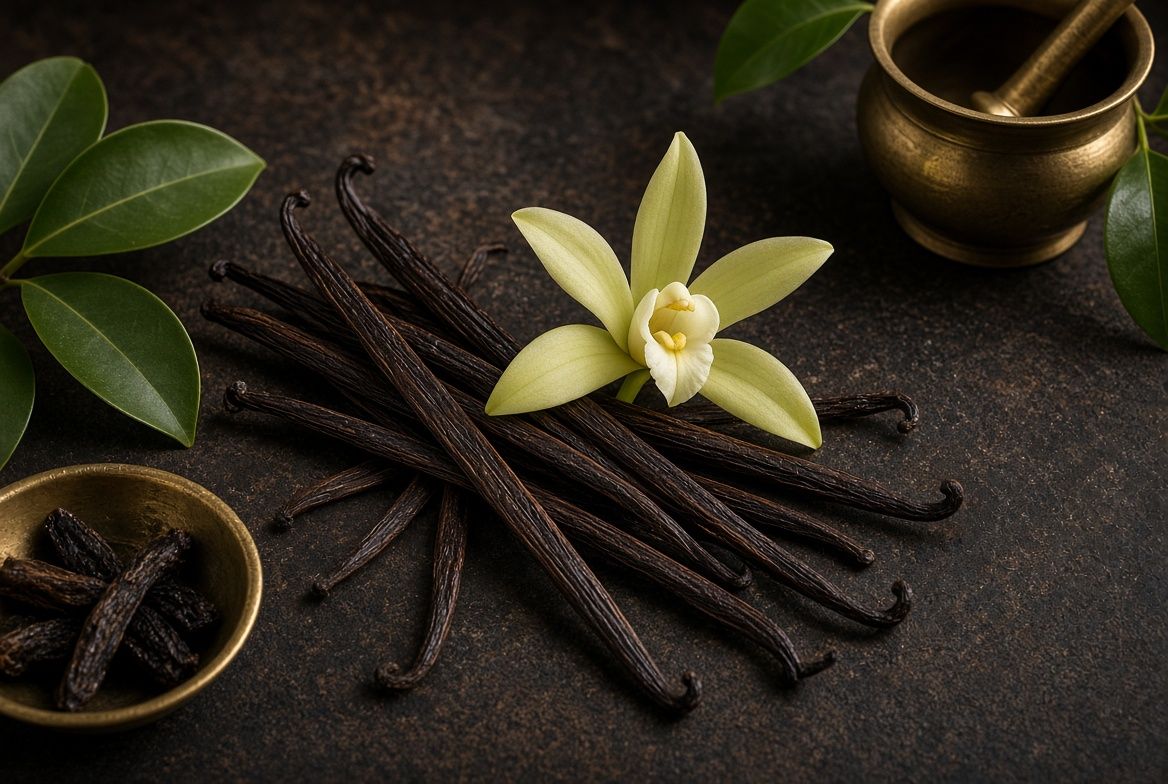
Botanical Identity & Classification
Inventory scope: Vanilla planifolia and other commercial Vanilla species · Orchidaceae · cured fruit capsule.
Nomenclatural check: Vanilla planifolia Andrews is accepted in this treatment (family Orchidaceae). A synonym listed there is Notylia planifolia (Andrews) Conz. The stated native range is S. Mexico to N. Brazil (Kew, Plants of the World Online: Vanilla planifolia Andrews).
Inventory decision: Specify species if known and distinguish cured pod, extract, vanilla flavor and isolated vanillin. Note carrier or alcohol on a product label; do not assume that visible specks authenticate a preparation.
The profile identifies Vanilla planifolia Jacks. ex Andrews as an orchid (Orchidaceae) and gives “flat-leaved vanilla” as its common name (Vanilla planifolia - Oxford University Plants 400).
Vanilla planifolia is an orchid whose long, thin fruits (pods) contain thousands of tiny black seeds (Vanilla planifolia | Plants - Kew Gardens).
Botanical & Scientific Profile
The cured capsule is a processed crop, not fresh fruit with a single fixed aroma. Distinguish whole cured fruit, extract and added vanillin in both a flavor record and an account of growers' work.
The Vanilla planifolia profile describes the species as a vine reaching up to 30 metres, with thick, fleshy stems, alternating leaves, and a root arising at each node (Vanilla planifolia - Oxford University Plants 400).
Vanilla is an evergreen vine that can reach 15 metres in length, with thick stems, greenish to yellow flowers, and fleshy aerial roots that cling to trees (Vanilla planifolia | Plants - Kew Gardens).
Vanilla seed capsules (beans) formed after pollination can reach about 20 cm (8 in) long and take eight to nine months to ripen. At maturity, the beans contain thousands of tiny, round, black seeds and split along two longitudinal seams (Vanilla Growing in South Florida).
The study compared conventional thermal scalding with high hydrostatic pressure (HHP; 20–600 MPa for 5 s or 5 min) treatment of green Vanilla planifolia pods during 20 sweating–drying curing cycles, monitoring glucovanillin, vanillin, and enzyme activity. Glucovanillin generally declined as vanillin accumulated, with selected HHP treatments producing higher vanillin concentrations than scalding at particular stages; the largest reported increases over scalding were 217.9% for 50 MPa/5 s and 211.2% for 200 MPa/5 s at cycle 12. The authors identify 50 MPa/5 min as a balanced condition associated with higher β-glucosidase activity during curing and superior vanillin levels compared with scalding, while 200 MPa/5 s was associated with glucovanillin loss, vanillin accumulation, and faster moisture loss (HighHydrostaticPressure-Assisted Curing of Vanilla planifolia: Effects on Moisture Loss, Phenolic Content, Enzyme Activities, and Antioxidant Capacity).
Cultural History & Traditional Herbalism
The profile says sixteenth-century Spanish conquistadors in Mexico encountered Aztec people using vanilla to flavour chocolate (Vanilla planifolia - Oxford University Plants 400).
The page states that Totonac and Olmec people in Mexico first used Vanilla planifolia to flavour food and drink (Vanilla planifolia | Plants - Kew Gardens).
Historical information in the publication states that Vanilla planifolia is native to Mesoamerica and began spreading beyond its native range in the late 1500s. Records indicate that it was imported into Florida from Mexico starting in 1899 and introduced from Florida into Puerto Rico before 1909 (Vanilla Growing in South Florida).
The authors report that Totonac vanilla producers in Papantla use manual self-pollination as one of the adaptive practices associated with cultivating Vanilla planifolia; this knowledge was documented through interviews and a participatory workshop. In the workshop’s biocultural-calendar discussions, producers identified drought as coinciding with flower pollination and pod development, stages they described as vulnerable to heat and water deficit. The article also states that the earliest documented plantations were established around 1767 by Totonac people in the Papantla and Misantla regions; it separately notes that Edmond Albius developed a hand-pollination technique in 1841, enabling cultivation to spread beyond the region (Annual and historical calendar of Vanilla planifolia Jacks. ex Andrews as an engine of transformation in Papantla, Veracruz (Mexico)).
Tradition, Folklore & Symbolism
No separate inherited symbolic or ceremonial use of this identified part was established here. A documented food, trade or medicinal practice should remain under its own description rather than being relabeled as ritual.
Herbal Energetics
Insufficient documented evidence for a traditional energetic classification. No temperature, direction or channel is inferred from the flavor of a cup.
InfiniTea sensory metaphor: Patient development. This is original editorial language, not a measured physiological action or a translation of a traditional diagnostic category.
Sensory Profile & Tea Applications
The Vanilla planifolia profile states that its flowers have a slight fragrance and that vanilla is used as a food flavouring and in the perfumery industry (Vanilla planifolia - Oxford University Plants 400).
Vanilla has a soft, sweet aroma and is an important ingredient in perfumery (Vanilla planifolia | Plants - Kew Gardens).
Sensory notebook: Compare a cured pod with a clearly labeled extract by aroma, not apparent sweetness. Record what the carrier contributes.
Proposed comparison, not a completed trial: Smell a labeled cured pod beside a separately labeled vanilla-flavored product. Record which descriptor belongs to which product without inferring its manufacturing method by nose.
For ordinary dried herbal or fruit infusions, the German Federal Institute for Risk Assessment advises using boiling water and not leaving the prepared infusion standing for hours. Cooling a hot infusion and steeping untreated dry material in cold water are different processes; this report does not validate the latter (Boiling water a must for herbal teas).
Safety & Responsible Use
21 CFR part 182 lists vanilla, sourced from Vanilla planifolia Andr. or Vanilla tahitensis J. W. Moore, among spices and other natural seasonings and flavorings generally recognized as safe for their intended use; it also lists vanilla among essential oils, oleoresins, and natural extractives. These listings concern intended uses under section 409 of the Act (21 CFR Part 182—Substances Generally Recognized as Safe).
Under 21 CFR § 169.175, vanilla extract is a solution in aqueous ethyl alcohol of the sapid and odorous principles extractable from vanilla beans. It must contain at least 35 percent ethyl alcohol by volume and at least one unit of vanilla constituent per gallon (Vanilla extract (§ 169.175)).
Preparation and exposure boundary: This review does not establish a safe medicinal dose in pregnancy, lactation or childhood, or rule out interactions or allergy. Do not substitute essential oil or a concentrated extract for the documented food or herb.
For U.S. food use, the relevant safety determination concerns the intended conditions of use. The existence of a traditional preparation or herbal medicine monograph does not establish that this ingredient, dose and beverage are cleared for sale (Understanding How the FDA Regulates Food Additives and GRAS Ingredients).
Historical Trade, Ecology & Sustainability
The profile says most Vanilla planifolia production takes place in Madagascar, Réunion, and the Comoro Islands, and, to a lesser extent, Indonesia and Mexico. It states that commercially produced vanilla is pollinated by hand and that one skilled worker can pollinate 1,000 to 2,000 flowers per day (Vanilla planifolia - Oxford University Plants 400).
Vanilla is now rare in the wild because of habitat reduction and overexploitation. It is the second most expensive spice after saffron because growing its pods requires intensive labour (Vanilla planifolia | Plants - Kew Gardens).
The profile states that Vanilla planifolia originates in Mexico and Central America, where it grows as a vine in humid, warm lowland forests and is naturally pollinated by bees native to those regions (Vanilla planifolia - Oxford University Plants 400).
Sourcing record: Request species, curing origin and traceability to growers; ask where pollination and curing work occurred rather than relying on the packing location.
InfiniTea Herb Lore & Ritualpreliminary draft
Energetics (original InfiniTea metaphor): Patient development. Use this as a private writing image, not a health statement.
Tradition & Folklore: No separate inherited symbolic or ceremonial use of this identified part was established here. A documented food, trade or medicinal practice should remain under its own description rather than being relabeled as ritual.
Ritual Cue (original contemporary InfiniTea interpretation): Write one line today and return to it tomorrow before changing it. Note what waiting allowed you to notice.
Private preliminary draft; not approved for publication.
Scholarly References & Research Verification
Research limitations
Ask which species, cure and origin are documented. A vanillin measurement alone cannot establish provenance, fair compensation or whole-pod authenticity.
The article does not detail the producers’ manual pollination technique or its precise timing (Annual and historical calendar of Vanilla planifolia Jacks. ex Andrews as an engine of transformation in Papantla, Veracruz (Mexico)).
References below identify the evidence used, not additional endorsements. A botanical authority establishes nomenclature, not the identity of a physical lot. Published study samples, traditional descriptions and InfiniTea proposals are distinguished in the text.
- Kew, Plants of the World Online: Vanilla planifolia Andrews | Taxonomic backbone
- Vanilla planifolia - Oxford University Plants 400 | botanical species profile
- Vanilla planifolia | Plants - Kew Gardens | botanical garden plant profile
- Vanilla Growing in South Florida | UF/IFAS Extension publication
- 21 CFR Part 182—Substances Generally Recognized as Safe | federal regulation
- Vanilla extract (§ 169.175) | U.S. federal regulatory standard of identity
- HighHydrostaticPressure-Assisted Curing of Vanilla planifolia: Effects on Moisture Loss, Phenolic Content, Enzyme Activities, and Antioxidant Capacity | laboratory study
- Annual and historical calendar of Vanilla planifolia Jacks. ex Andrews as an engine of transformation in Papantla, Veracruz (Mexico) | Open-access research article using producer interviews and participatory workshops to document vanilla cultivation knowledge and its annual and historical changes in Papantla.
- Boiling water a must for herbal teas | BfR press release providing general food-safety guidance for preparing herbal and fruit infusions.
- Understanding How the FDA Regulates Food Additives and GRAS Ingredients | U.S. FDA consumer-information webpage describing food-additive and GRAS ingredient oversight.
Final Botanical Summary
The flavor of a cured orchid fruit carries a history of pollination, curing and labor that the word vanilla on a label may not represent.
Editorial disposition: Lot unverified. The report is a private reference, not a clinical recommendation, approval for sale or authenticated sensory trial.
Verification Status (November 2026)
Phase II source audit, claim by claim
- Claims checked
- 15
- Corrected
- 2
- Withheld
- 0
- Sources
- 10
Material: Lot unverified. No physical sample has been examined.
Citation check: All 3 Safety & Use citations were re-read against their sources in November 2026 and confirmed.
A private research reference, not a clinical recommendation or product claim. Checked to the Grimoire's research standards →